
Developer Resources
What Is Jev Model? A Practical Guide to Typed AI Decisions
What is Jev Model? Learn how this System One model turns shared state and typed questions into structured, probability-backed decisions for routing, guardrails, scoring, and AI workflows.

What Is Jev Model? A Practical Guide to Typed AI Decisions
If you search for what is Jev Model, the shortest useful answer is this: Jev Model is a probabilistic AI model for decisions that software needs to consume directly. You send it a piece of state—such as a support ticket, an agent context, or a structured record—and ask one or more typed questions. Jev returns typed answers, probabilities, and, for Choice and Score questions, confidence information that your application can use in its own control flow.
That makes Jev different from a chat-first large language model. A traditional LLM is usually asked to generate language, an explanation, or a flexible JSON document. Jev is designed for the smaller decisions hidden inside a product: which queue should receive this ticket, whether a tool call needs approval, how urgent a request is, or which approved model should handle the next step.
This guide explains what Jev Model is, how it works, where it belongs in an AI stack, and how to evaluate it without giving the model authority over your application. If you want the product-level definition first, start with the official Jev Model overview, then use the examples below as an implementation guide.
Table of contents
- What is Jev Model in one sentence?
- Why Jev is a System One model
- How Jev Model works
- The three Jev question types
- Where Jev fits beside an LLM
- A practical routing example
- Probability, confidence, and safe automation
- How to start with Jev Model
- Limits and evaluation checklist
- Jev Model pricing and access
- Frequently asked questions
What is Jev Model in one sentence?
Jev Model turns a shared state and a set of typed questions into structured decisions that code can branch on, sort, route, or store.
The phrase System One model describes the intended interaction. The model is not primarily a chat window for producing a long answer. It is a machine-facing decision component. Your application defines the answer boundary first, Jev evaluates the state inside that boundary, and your own code decides what happens next.
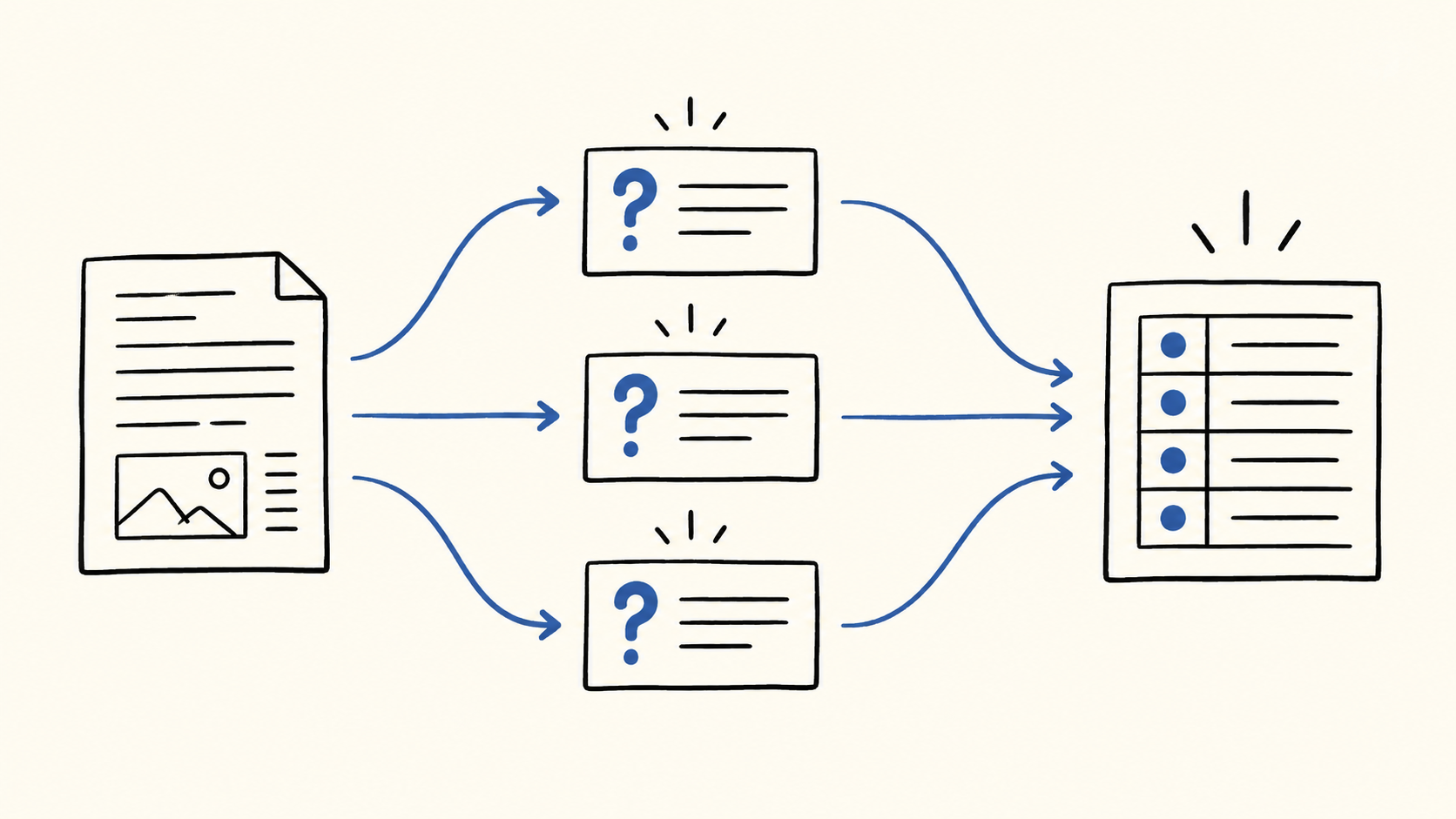
This separation matters because many production workflows do not need another paragraph. They need a value with a known shape:
billing,technical, orsalesfor ticket routing;- a score from a documented urgency rubric;
- a yes probability for “does this action need human approval?”;
fast-modelorreasoning-modelfrom an allowlist;- a decision to continue, ask for clarification, or escalate.
Jev does not replace your queue, permissions, policy, retry logic, or audit trail. It supplies a judgment that those deterministic systems can use.
Why Jev is a System One model
The useful contrast is not “Jev versus all LLMs.” It is open-ended generation versus bounded software decisions.
A chat-first LLM optimizes for language. It can write, summarize, explain, brainstorm, and reason through an unfamiliar problem. Its output is intentionally flexible. That flexibility is valuable when a person needs a natural answer, but it also creates work for software: parsing, schema validation, refusal handling, extra tokens, and checks for whether the response actually answered the intended question.
A System One model starts with a narrower contract. You provide a state and define questions using a small set of answer types. The output stays close to that contract, and the result includes probability signals that can influence the next branch.

| Concern | Chat-first LLM | Jev Model |
|---|---|---|
| Primary job | Generate language or open-ended reasoning | Make bounded decisions for software |
| Interface | Prompt plus context | State plus typed questions |
| Output | Text or flexible structured content | Choice, score, or Noul answer |
| Multiple decisions | Often chained or parsed from one response | Multiple questions can use one state in parallel |
| Uncertainty | Usually needs a separate method | Probability is part of the result; Choice and Score also expose confidence |
| Final action | May be mixed into the answer | Remains in your application code |
This is why Jev is best understood as a layer inside a system, not as a replacement for every model. An LLM can draft a response; Jev can decide whether the request belongs in billing, whether the draft needs review, or whether a tool call is inside an approved boundary.
How Jev Model works
Jev follows a compact four-part loop: prepare state, define questions, read typed answers, and let application code act.
1. Prepare the state
State is the context shared by every question in a request. It can be a plain string, a JSON object, or an array of text. A string is enough for a simple ticket. An object is more useful when the answer depends on several fields, such as customer tier, order status, policy version, and the latest message.
Good state is specific enough to support the decision and small enough to avoid irrelevant context. Include the facts that a reviewer would use, not an entire database row by default. If a field contains secrets or personal data, remove or minimize it before sending the request.
The current input boundary is important: Jev Model accepts text, JSON objects, and arrays of text. Images, audio, and video are not direct state inputs at this time. If your workflow starts with a screenshot or recording, use an appropriate preprocessing step first, then send the resulting text or structured facts to Jev.
2. Define small, typed questions
Each question should represent one judgment. “Analyze this customer and decide everything” is too broad because it hides intent, urgency, sentiment, fraud risk, and the desired action in one instruction. Split those dimensions so each one has a clear rubric and can be evaluated independently.
Multiple questions can read the same state in one request. That is useful when a ticket needs an intent label, an urgency score, and a human-review judgment at the same time. The questions are parallel decision inputs; your code can combine the results afterward.
3. Read the structured response
The response uses the same question IDs that you send. Choice returns the selected option, probabilities for the available options, and confidence. Score returns a probability-weighted score, a legend for the levels, probabilities, and confidence. Noul returns a number from 0 to 1 representing the probability that a yes/no statement is true; it does not return a separate confidence field.
You should still validate the HTTP status, response shape, and allowed values at your application boundary. A typed result reduces parsing ambiguity, but it does not remove the need for defensive programming.
4. Let your code act
Jev answers the question. Your system owns the move. A result can call route_ticket(), put a case in a queue, block a tool, request confirmation, or pass the state to a larger reasoning model. Keep authorization checks, irreversible actions, rate limits, and audit logs outside the model.
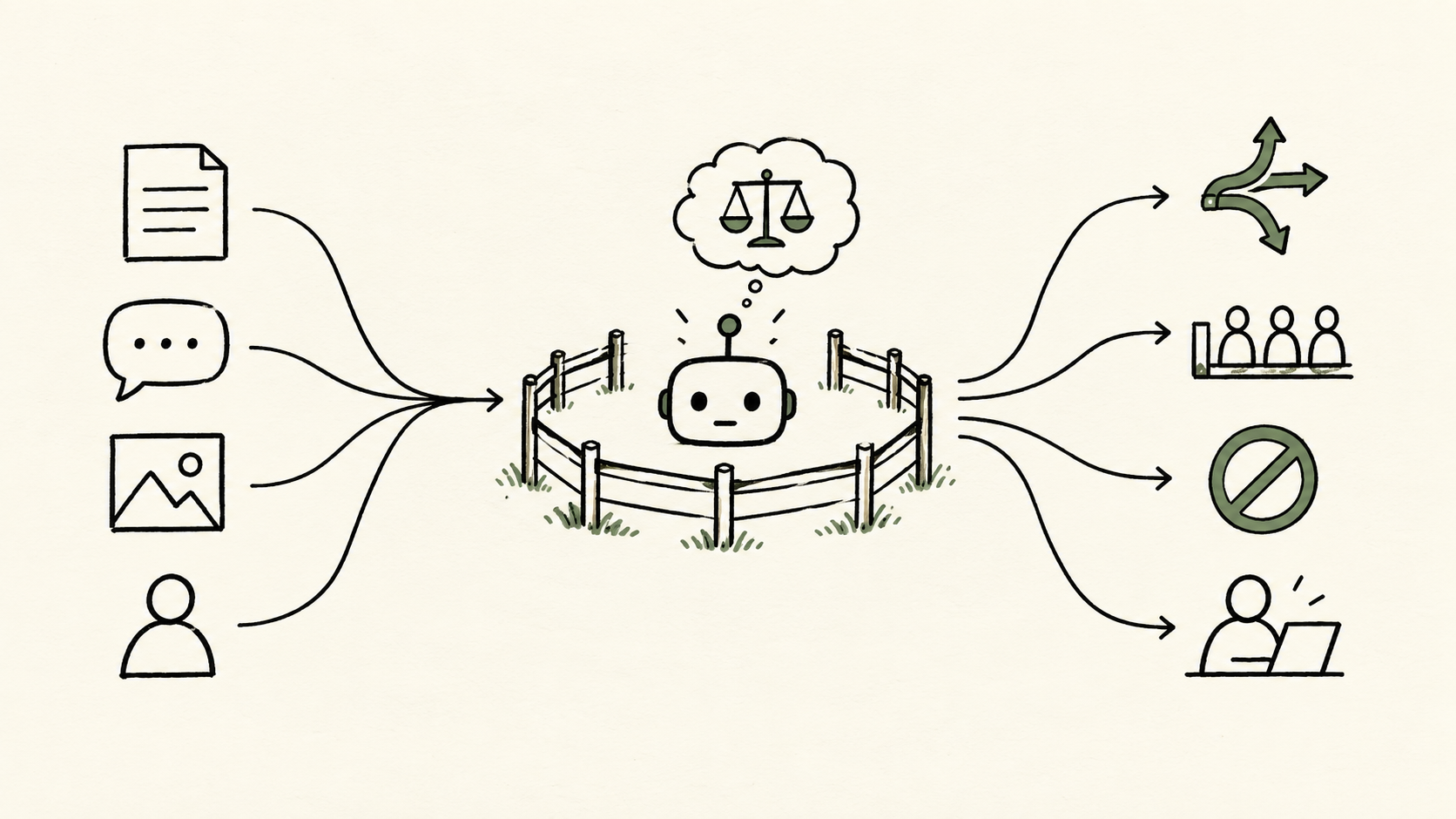
This boundary is the main production design principle: model the judgment, but do not model away the control plane.
The three Jev question types
The three primitives are intentionally simple. Choosing the right one makes the output easier to test and the policy easier to change.
Choice: select from an approved set
Use Choice when the answer must be one option from a known list. Common examples include:
- assigning a support ticket to billing, technical support, account, or sales;
- choosing a fast or reasoning model from an allowlist;
- classifying a document into an approved content category;
- selecting the next workflow branch.
The criteria should describe what each option means. If unknown cases are possible, include an other, unknown, or needs_review option rather than forcing every state into a bad category. The returned probability distribution can also reveal when two options are close.
Score: rate against an ordered rubric
Use Score for a spectrum such as low, medium, and high urgency. It is also useful for risk, quality, satisfaction, or operational impact. Define the levels in order and describe them concretely. “High” is not a useful rubric by itself; “customer-facing outage requiring attention within one hour” gives the model and your reviewers a clearer boundary.
The score is probability-weighted, so it can fall between the levels. That makes it useful for ranking queues, but do not confuse a ranking signal with a business policy. Your code still decides which score triggers escalation and how exceptions are handled.
Noul: judge whether a statement is true
Use Noul for a focused yes/no judgment. Examples include:
- “Does this request explicitly ask for a refund?”
- “Should this tool call require human approval?”
- “Does the message describe a production outage?”
Noul returns the probability that the statement is true. It is a good primitive for guardrails and escalation checks, as long as the statement is precise. If a decision contains several independent conditions, ask several Noul questions and combine them in code instead of hiding all conditions in one sentence.
Where Jev fits beside an LLM
Jev and a generative LLM solve different parts of an AI workflow. The strongest architecture often uses both.

Use a generative LLM when you need a long explanation, a draft, a summary, novel code, or open-ended reasoning. Use Jev when the application needs a bounded signal before or after that generation:
- Route before generation. Decide whether a request is simple enough for a fast model or needs a deeper model.
- Guard a tool call. Check whether intent is explicit and whether the action needs approval before deleting data, charging a card, or changing permissions.
- Triage a queue. Classify intent, score urgency, and decide whether to hand off to a person.
- Verify a completion. Ask whether a task meets a defined checklist before reporting success.
- Preserve control during long workflows. Use a small decision node to decide what context remains important when an agent compresses a session.
The pattern is “Jev decides, code controls, the LLM generates when generation is needed.” This keeps the decision boundary visible instead of burying policy in a long prompt.
A practical routing example
Imagine a support service that receives this state:
{
  "message": "My annual plan was charged twice and I need a refund today.",
  "customer_tier": "business",
  "channel": "email"
}
The service could ask three questions against the same state:
{
  "model": "jev-latest",
  "state": {
    "message": "My annual plan was charged twice and I need a refund today.",
    "customer_tier": "business",
    "channel": "email"
  },
  "questions": {
    "team": {
      "type": "choice",
      "instructions": "Which approved team should handle this request?",
      "criteria": {
        "billing": "Payments, invoices, duplicate charges, or refunds",
        "technical": "Bugs, outages, or integrations",
        "account": "Login, profile, or workspace access",
        "sales": "Pricing, upgrades, or new accounts"
      }
    },
    "urgency": {
      "type": "score",
      "instructions": "How urgent is this for operations?",
      "criteria": ["Routine", "Needs attention soon", "Time-sensitive"]
    },
    "needs_human": {
      "type": "noul",
      "instructions": "Does this request need a person before any refund action?"
    }
  }
}
The application can then apply policy: route to billing, sort using urgency, and require human confirmation before money moves. Jev does not refund the customer, change the account, or override payment permissions. It gives the service a structured signal for those decisions.
Probability, confidence, and safe automation
Probability is useful because not every state deserves the same amount of automation. It is not a guarantee of business accuracy.
For Choice, a concentrated distribution may indicate a clear winner; a flat distribution suggests ambiguous input, overlapping criteria, or a missing option. Score provides a similar distribution across levels. Noul gives a yes probability directly. Choice and Score also expose confidence derived from their distributions.

Use a risk-based policy rather than one universal threshold:
- Low risk and reversible: automate classification or display decisions with a conservative correction path.
- Medium risk: proceed with a confirmation, sample results, or route ambiguous cases to review.
- High impact or irreversible: combine model signals with deterministic authorization, policy checks, audit logs, and human approval.
The threshold belongs to your product. A read-only label can tolerate more uncertainty than a deletion, payment, or permission change. Measure the result on your own labelled examples and review false positives as well as false negatives.
How to start with Jev Model
The fastest path is to validate one decision, not an entire autonomous workflow. Use the Jev Model Playground to enter a real but low-risk state, define one or two questions, and inspect the structured result.
When the decision is useful, follow the Jev Model developer documentation to create an API key and connect the endpoint from a server-side service. A minimal REST request looks like this:
curl -X POST https://jevmodel.net/v1/systemone \
  -H "Authorization: Bearer $JEV_API_KEY" \
  -H "Content-Type: application/json" \
  -d '{
    "model": "jev-latest",
    "state": "Three deploys failed and production is returning 500s.",
    "questions": {
      "needs_human": {
        "type": "noul",
        "instructions": "Should this be escalated to a person now?"
      }
    }
  }'
Keep the API key in a server-side environment variable. Before shipping, add input minimization, timeout and retry handling, response validation, logging without sensitive state, and a fallback for 429 or temporarily overloaded responses. Record the question definition and model version if you need decisions to be replayable.
Limits and evaluation checklist
Jev is a focused decision component, so it is not the right tool for every task. It is a poor fit when you need a long narrative, unrestricted brainstorming, raw media understanding, or an answer space that cannot be described in advance. Use a generative or multimodal model for those parts, then use Jev as a router or validator when the decision becomes bounded.
Before production, evaluate:
- Label quality: Do humans agree on the correct answer and rubric?
- Boundary cases: What happens when no option fits or two options are equally plausible?
- Language coverage: Does performance hold for the languages and terminology your users actually send?
- Risk controls: Which actions are reversible, and which require deterministic checks or approval?
- Operations: What are the latency, rate-limit, retry, and fallback behaviors at your target concurrency?
- Observability: Can you inspect the state version, question version, result, threshold, and final action without exposing private data?
The most valuable first use case is usually small and measurable: reduce manual ticket sorting, prevent an unsafe tool call, or send only difficult requests to an expensive reasoning model.
Jev Model pricing and access
The public plans currently include Starter, Pro, and Enterprise access with different durations, workspaces, concurrency limits, and support levels. The product page describes unlimited usage during the purchased access period, with Starter intended for validating one workflow, Pro for production integration, and Enterprise for team collaboration and custom integrations.
Pricing and plan details can change, so check the current Jev Model pricing page before budgeting or publishing a comparison. For cost planning, estimate the number of decisions, questions per request, input size, retries, and the percentage of cases that will still require human review.
Frequently asked questions
Is Jev Model a chatbot?
No. Jev Model is designed for software to consume typed decisions. It can be part of a chatbot or agent, but its role is usually to classify, score, guard, route, or verify rather than write the final conversational reply.
Is Jev Model the same as a large language model?
It is an AI model, but the interface and intended job are different. An LLM is strong at open-ended language and reasoning; Jev is designed for bounded judgments with a defined output shape. A product can use both.
What does “System One” mean here?
It refers to a machine-facing model pattern: the input is state plus typed questions, and the output is a structured decision with probability signals. The name emphasizes software consumption rather than a chat-first interaction.
What is the difference between Choice, Score, and Noul?
Use Choice to select one option, Score to rate a state against ordered levels, and Noul to judge whether a precise statement is true. Choice and Score return probability distributions and confidence; Noul returns the yes probability.
Can Jev replace my LLM?
Usually not. Keep generation, summarization, and open-ended reasoning with a suitable LLM. Use Jev for the bounded control decisions around those capabilities, such as model routing, tool-call checks, queue triage, and completion verification.
Does a high probability mean the answer is correct?
No. Probability and confidence are control signals, not a business-accuracy guarantee. Test on representative data, set thresholds by risk, and keep a human or deterministic fallback for consequential actions.
What should I try first?
Choose one low-risk decision with a clear answer space and a measurable outcome. Try it in the Playground, then connect it server-side with the API. Keep the first workflow narrow enough that you can inspect errors and improve the rubric.
Conclusion: make one small decision dependable
So, what is Jev Model? It is a System One model that turns real-world context into typed, probability-backed decisions for software. Its value is not that it can generate another paragraph; its value is that it makes the small judgments inside an agent or workflow explicit, inspectable, and usable in code.
Start with one decision: route a ticket, score urgency, check a tool call, or choose an approved model. Define the answer boundary, send the smallest useful state, inspect the probabilities, and keep the final action in your application. That is the practical way to use Jev Model—as a decision layer that makes AI systems easier to control, measure, and evolve.
Research date: 2026-09-25
Primary source: Jev Model official website and developer documentation.